AI script analysis – how script breakdown works in FilmProduct (FPMS)
What a script breakdown is, what it covers and how AI does it in FilmProduct (FPMS). A checklist for verifying the breakdown before the shooting schedule.

The breakdown is the first truly production-minded reading of a script. The director reads the text as a story, while the 1st AD and the production manager read it as a list of things, people and places that have to be organised, paid for and put into the calendar. Everything that happens later depends on the quality of this analysis: the shooting schedule, the departments’ requirements lists and the budget. In this article we recap what a classic breakdown looks like, show how AI supports this work in the FilmProduct (FPMS) system, and provide a checklist for verifying the result.
What a breakdown is in classic practice
Traditionally, a breakdown is done by hand: the script is divided into scenes, each is given a number, the setting (interior/exterior), the time of day (day/night) and the length are noted, and then all the production elements are marked in the text – often with colours assigned to categories. These markings produce breakdown sheets, and those in turn produce the shooting schedule and the budget.
Typical categories of elements:
| Category | Examples | Who needs the information |
|---|---|---|
| Cast | speaking roles, bit parts, doubles, stunt performers | casting, 1st AD, producer |
| Extras and background | a crowd at a railway station, wedding guests | 1st AD, extras casting |
| Locations and sets | the main character’s flat, a street, a car interior | location manager, production designer |
| Props | a phone, a weapon, documents, food eaten on camera | props master |
| Costumes and make-up | costume changes, wounds, ageing | costume designer, make-up artist |
| Vehicles | picture cars, period vehicles | vehicle coordinator, transport |
| Effects | rain, smoke, fire, visual effects | effects department, VFX |
| Animals, special equipment | a dog, a horse, a crane, a drone, work on water | production manager, head of department |
A manual breakdown is labour-intensive and requires experience. The biggest risk, however, is not the pace itself but keeping it up to date: the script changes several times, and every new version requires a review of the analysis and of all the documents that follow from it.
How FilmProduct does it
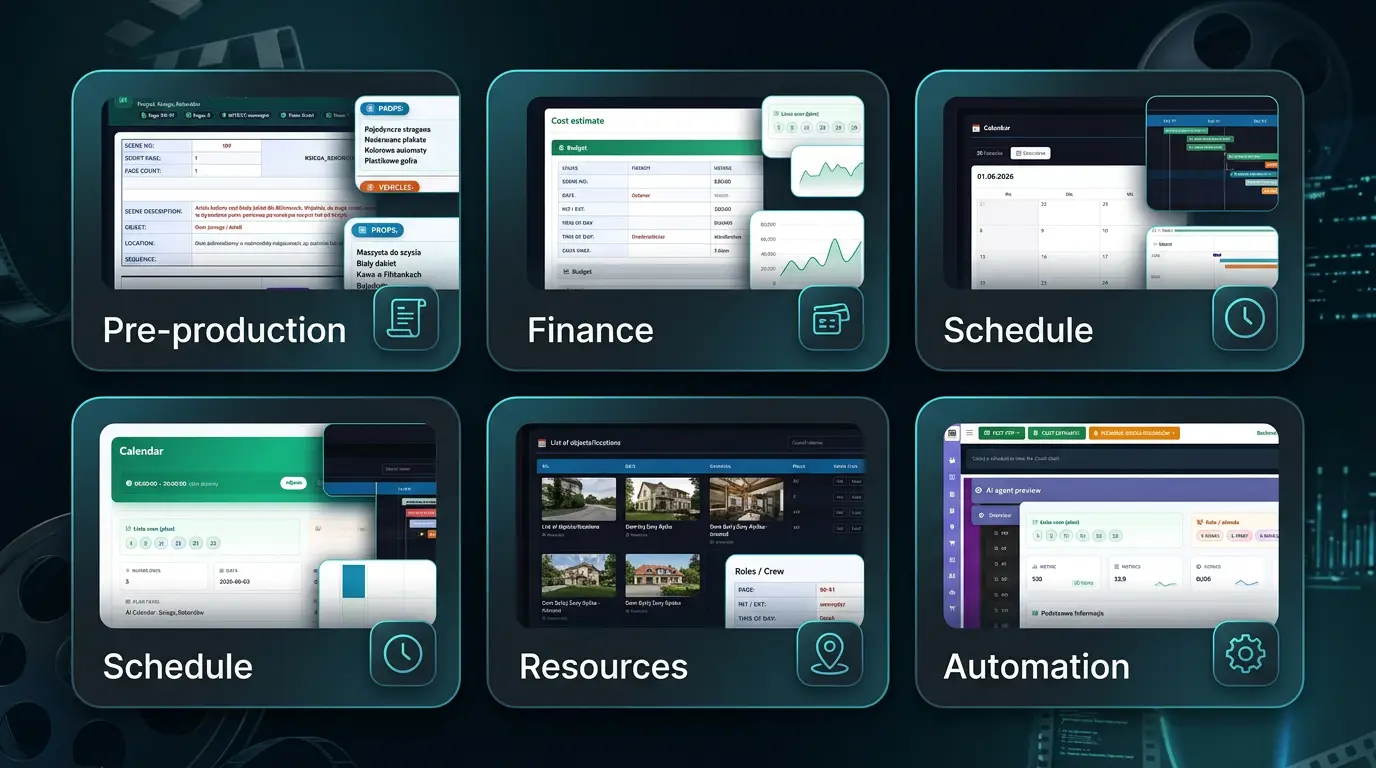
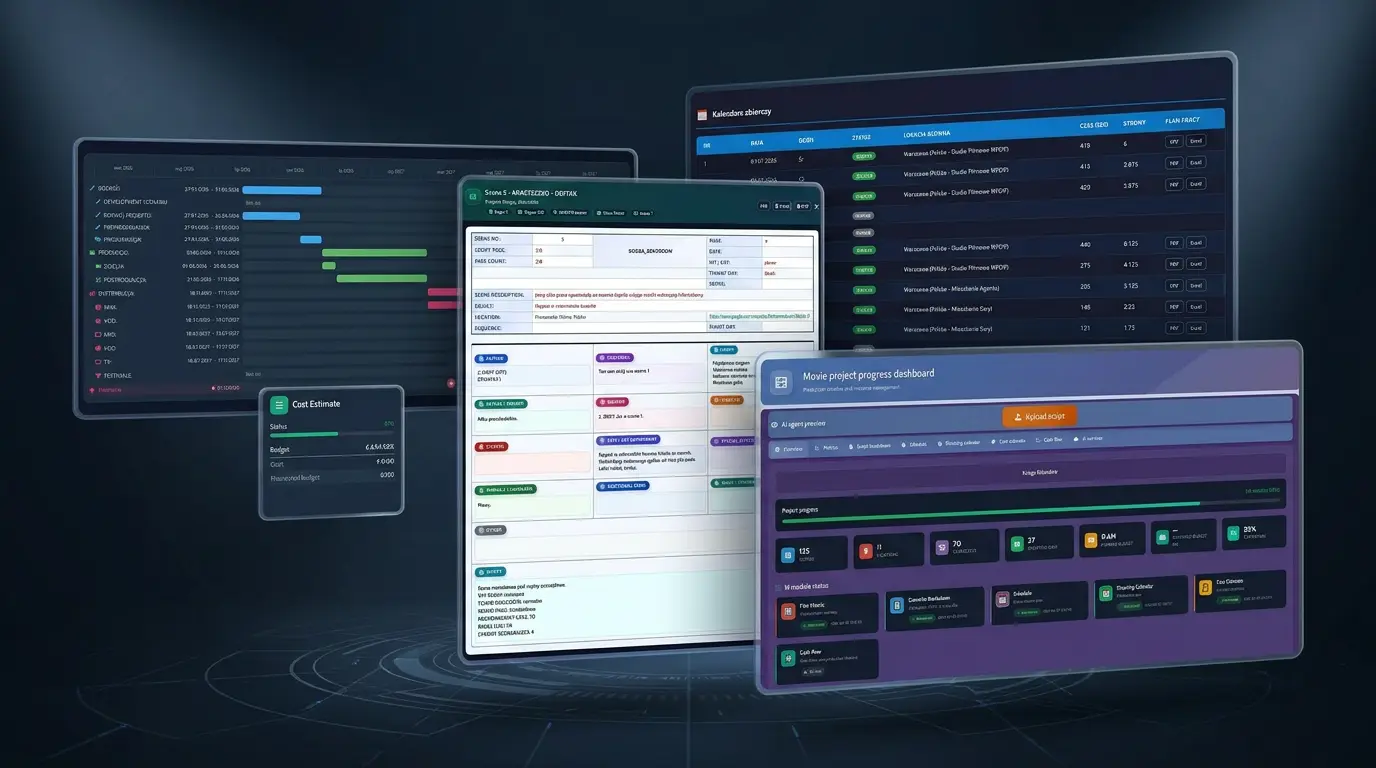
In FilmProduct, the breakdown starts with uploading the script to a new production project. According to the documentation, the system uses AI to automatically identify scenes and production elements, and then creates:
- scene cards – scene data, cast, locations and production requirements,
- set cards – editable data on sets and production elements, including locations and props,
- production requirements lists – the elements that have to be prepared for the shoot.
In the product’s terminology, one “full AI script analysis” is one AI pass through the entire script, which produces the scene cards, set cards and requirements lists for that version of the text.
The most important principle is written into the documentation explicitly: every result prepared by AI can be checked and corrected. Scene cards, set cards and production requirements are editable, and the production documents are generated from the team’s corrections. AI does not make production decisions – it does the first, tedious pass through the text, which is then verified by people who know the project.
Why verification is essential
A script does not always say everything explicitly. A few typical situations in which the team’s knowledge is needed:
- implied elements – “they pull into the car park outside the hospital” means a vehicle, but also a car park and possibly extras,
- directing decisions – whether a flashback scene needs separate costumes and make-up is something the director knows, not the text,
- production decisions – whether we shoot two places from the text in a single location is decided by the production manager,
- continuity – wounds, costume changes and props that carry over between scenes,
- safety – stunts, weapons, fire, water and work at height require separate arrangements.
Checklist for verifying an AI breakdown
Before the analysis goes into the shooting schedule and the budget, it is worth going through it against this list. This is usually done by the 1st AD and the production manager, while the heads of department check their own categories.
- Scene numbering and the number of scenes match the current version of the script.
- Interior/exterior and day/night are correct for every scene – the grouping of shooting days depends on this.
- Cast: every speaking character is assigned to the correct scenes; bit parts and non-speaking roles are distinguished.
- Extras: scenes with background have an estimated number of people.
- Sets: the same settings do not appear under different names.
- Props and vehicles: action props and picture vehicles are separated from set dressing.
- Costumes and make-up: changes and continuity elements are marked.
- Effects and situations requiring safety measures: stunts, fire, weapons, water, animals, children on set.
- Notes from the director and the cinematographer from table reads and location scouting have been added to the cards.
- The script version is clearly marked, and the whole team is working from the same one.
Good practice: verification ends with a short conversation among the heads of department over the requirements lists. Things that slipped past both AI and people most often come out at exactly that point.
What happens when the script changes
In the “many files” model, a change to a scene means manual corrections to the breakdown, the schedule, the requirements lists and the budget – and the risk that one of the documents will be left out of date. FilmProduct reverses this logic: the same data from the analysis feeds the production documents, the shooting schedule and the budget. A correction to a scene card is therefore a correction to the project, not to one of many spreadsheets.
When the text is substantially rewritten – new scenes, a storyline cut – a new full analysis can be run for the new version of the script. The number of full analyses depends on the subscription plan; details are on the FilmProduct website. Whether changes are made manually or through a new analysis, the same rule applies: the team checks the result before it goes into the shooting schedule.
The breakdown as the foundation for further work
A well-verified breakdown is the basis of the shooting schedule and the budget – how the shooting schedule and the budget are built from the same data is covered in the article shooting schedule and budget from one script. Already at the development stage, an initial analysis helps assess the scale of the project, and in production management it is an everyday working tool. If you are only just estimating the budget, also take a look at how much does it cost to make a film.
When uploading a script to any AI tool, it is worth knowing what happens to the text – we discuss this in the article on script security. You will find a full description of the system in the guide FilmProduct (FPMS) – a film production management system.
See a breakdown on your own project
The simplest way to see how the analysis works is a demo – a 20-minute 1:1 meeting, online or in person, which you can book at filmproduct.com. If you want to implement the system on a production, or you need a team that will prepare and verify the breakdown together with you, get in touch with Holly Łódź.
FAQ
Frequently asked questions
01What is a script breakdown?
A breakdown, or script analysis, means breaking the text down into scenes and the elements needed to shoot them: cast, extras, locations, props, costumes, make-up, vehicles, effects, animals or special equipment. The shooting schedule, the departments’ requirements lists and the budget are built on it.
02What exactly does AI do in FilmProduct?
Once the script is uploaded, the system identifies scenes and production elements, and then creates editable scene cards, set cards and production requirements lists. One full AI script analysis is one pass through the entire text in a given version.
03Can the result of the AI analysis be corrected?
Yes. Every scene card, set card and production requirement is editable, and the production documents are generated from the corrected data. Verification by the 1st AD, the production manager and the heads of department is part of the process, not an add-on.
04What happens when the script changes?
Changes are made in the project data that feeds the documents, the shooting schedule and the budget – there is no need to retype the same information in several files. When the text is substantially rewritten, a new full analysis can be run for the new version of the script.